


Toilets, Periods and Equality: What World Toilet Day Means for Anyone Who Menstruates
This World Toilet Day, the UN is asking the world to see sanitation as a gender equality issue. Our founder Martha Silcott explains why that conversation has to go all the way inside the cubicle.
On Thursday 19 November, the world marks World Toilet Day. It is the United Nations day for the global sanitation crisis, and every year it focuses on one part of the problem. In 2026, the theme is Safe toilets. Equal futures. The message from the UN is simple: sanitation is foundational to gender equality.
At FabLittleBag, that sentence could be our mission statement. We exist because of one very ordinary toilet, at a friend's house, with no bin in it. So we asked our founder, inventor and CEO, Martha Silcott, what World Toilet Day means to her.
"You cannot achieve gender equality without sanitation equality. Every woman deserves a toilet where she can manage her period safely, hygienically and with dignity. Period." Martha Silcott, founder of FabLittleBag
In this article, we look at what this year's theme means, what sanitation equality looks like in a UK cubicle, why period products still end up down the toilet, and the simple things workplaces, schools, venues and all of us can do about it.
What World Toilet Day is, and why this year matters
World Toilet Day is an official United Nations observance, held on 19 November every year. It exists because billions of people still do not have a safe toilet, and because that gap shapes health, education, work and safety in ways that are easy to overlook if you have never had to think about it.
The 2026 campaign puts women and girls at the centre. According to the UN, safe toilets help women and girls stay healthy, safe and dignified, and allow them to go to school, go to work and take part in public life. The figures it shares, drawn from WHO and UNICEF data, show how far there is to go:
- 4 in 10 people worldwide, around 3.4 billion, do not have access to a safe toilet (WHO/UNICEF, 2025)
- 1 in 5 girls aged 10 to 19 has to share unhygienic toilets with other households or go in the open (WHO/UNICEF, 2023)
- Fewer than 1 in 3 schools worldwide have bins for menstrual waste in girls' toilets (WHO/UNICEF, 2024)
That last figure is the one we keep coming back to. The 2024 WHO and UNICEF report on school sanitation found that just 31% of schools globally have a bin for menstrual waste in girls' toilets, falling to 17% in the least developed countries and 11% in sub-Saharan Africa.
A toilet without a bin is still a toilet. But for anyone on their period, it is only half a solution.
Sanitation equality starts inside the cubicle
When people talk about access to sanitation, they usually mean access to the toilet itself: is there one, is it clean, is it safe to get to, does the door lock? Those things matter enormously. But Martha's point is that the conversation often stops at the cubicle door.
"We talk a lot about gender equality. But what about sanitation equality? A toilet isn't truly inclusive if women can't manage their periods safely, hygienically and with dignity. It's not just about access to a loo. It's about what happens inside it."
Managing a period away from home involves a short, practical checklist. Somewhere private to change. Water and soap to wash your hands. And somewhere to put the used product. If any of those are missing, the person on their period has to improvise, and improvising in a toilet cubicle is rarely dignified.
This is what sanitation equality means in practice. It is not only about whether a toilet exists. It is whether the toilet works for everyone who uses it, including the roughly half of the population who will spend years of their life needing to change and dispose of a pad or tampon.
The UK version: a cubicle with no bin
It would be easy to read the global figures and think this is a problem for somewhere else. But ask almost anyone who has periods in the UK and they will have a story about a cubicle with no bin. A friend's bathroom. A restaurant. An office on a client visit. A train. A school.
That is exactly where FabLittleBag began. At a dinner party, Martha needed to change her tampon, found there was no bin, and ended up wrapping it in toilet roll and carrying it out in her handbag. We asked her what made her start the business.
"It was what I wasn't seeing: no bin, forcing me to do the Handbag Smuggle. Ugh!"
The Handbag Smuggle is a small thing, but it carries a big message. We asked Martha what a cubicle with no bin says to someone on their period.
"That they don't matter, and they're on their own when it comes to disposal."
In UK workplaces, the expectation is already written down. The Health and Safety Executive's Approved Code of Practice for the Workplace (Health, Safety and Welfare) Regulations 1992 says that "in toilets used by women, suitable means for the disposal of sanitary dressings should also be provided." In other words, a bin in the cubicle is not a nice extra. It is part of what a suitable workplace toilet looks like.
Yet the gaps are everywhere: the single accessible toilet with no bin, the gender-neutral cubicle where nobody thought about periods, the staff toilet where the bin is overflowing or broken, the bin that sits by the sinks rather than inside the cubicle. Each one leaves someone choosing between the Handbag Smuggle and the toilet bowl.
Why period products still get flushed
When there is nowhere to put a used tampon or pad, a lot of people flush it. Not because they do not care, but because in that moment it feels like the only option that keeps things private.
We asked Martha why flushing still happens, and what would change it.
"Ingrained habit, a lack of awareness, and people being put off by wrapping used products in loo roll."
All three are real. Many of us were never told that tampons should not be flushed. Others have flushed for years because that is what everyone around them did. And wrapping a used product in a wad of toilet paper, then hunting for somewhere to put it, is unpleasant enough that the toilet starts to look like the easy way out.
Embarrassment plays a part too. In research by the hygiene company phs, 41% of respondents admitted flushing tampons to hide their period.
The cost of all those private decisions is very public. Water UK, the body that represents the UK's water companies, estimates that the country's sewers suffer around 300,000 blockages a year, costing about £100 million to clear. The study behind those figures found wipes made up most of the material, but the lesson applies to everything that is not designed to be flushed, period products included. What goes down the toilet can also end up in rivers and on our beaches.
The rule to remember is simple: only the three Ps go down the toilet, which are pee, poo and paper. If you want to know more, our guides to the Three P's Rule and whether you can flush tampons explain why, and Why 40% of UK Women Still Flush Period Products looks at the habit in more detail.
What would actually change it
Telling people not to flush only goes so far. Behaviour changes when the better option is also the easier one. That means three things:
- A bin within reach, inside every cubicle, not by the sinks or down the corridor
- A way to wrap the product that is not loo roll, so disposal is quick, hidden and hygienic
- Talking about it, so that disposing of a period product is treated as normal rather than something to hide
That is the gap FabLittleBag was designed to fill: an opaque, sealable bag that opens with one hand, so a used tampon, pad or liner is wrapped, sealed and out of sight in seconds.
One thing every workplace, school and venue can do this week
We asked Martha for the single most practical thing an organisation could do this World Toilet Day. Her answer was refreshingly simple.
"Get a FabLittleBag Dispenser in their loos, for less than £30!"
A dispenser on the cubicle wall or door means nobody has to bring their own solution. It tells everyone who walks in that periods have been thought about here, and it makes the right choice the easy one.
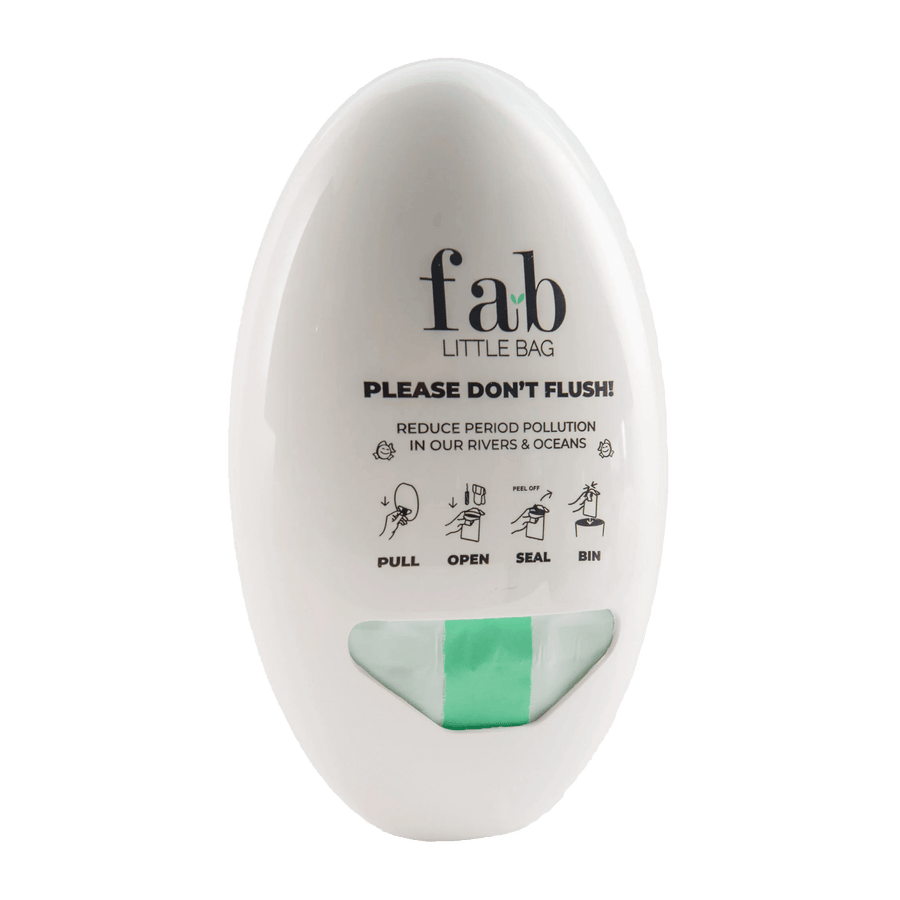
From our shop
FabLittleBag Dispenser · £29.00
A compact dispenser that holds up to 40 FabLittleBags and fixes to a cubicle wall, door or cupboard, so every visitor has a discreet, sealable bag within reach. The simplest way to make your toilets Period Supportive.
If you look after toilets used by other people, here is a quick World Toilet Day audit you can do in an afternoon:
- Walk every cubicle, including accessible and gender-neutral toilets, and check there is a working bin inside each one
- Do not forget the men's toilets. Men who use incontinence pads need a bin too, and most men's toilets do not have one. Our guide to men and incontinence explains why
- Add disposal bags next to the bin, ideally in a wall-mounted dispenser so they stay clean and dry
- Put up a simple sign reminding people not to flush period products, and telling them what to use instead
- Consider free period products, so nobody is caught out
- Check the bins are emptied often enough, because an overflowing bin is almost as off-putting as no bin at all
- Ask the people who use the toilets what is missing. They will tell you.
For businesses, schools, sports clubs and venues that want to go further, our Period Supportive movement gives you a clear standard to work towards. Organisations earn the Period Supportive Kitemark by providing free period products and FabLittleBags in their toilets. It is a visible way of showing staff, students, members and visitors that you have thought about them. You can read more about the business case in The Cost of Ignoring Period Care in Businesses.
What you can do, wherever you are
You do not need to run a building to make a difference this World Toilet Day.
Carry your own. Keeping a few disposal bags in your bag, car or desk drawer means the Handbag Smuggle never has to happen again, wherever you are.

From our shop
The Fab 45 (+ carry case) · £10.00
Forty-five FabLittleBags plus a discreet carry case for your bag. One-handed opening, opaque and sealable, so a used product is wrapped and out of sight in seconds. Made mostly from plants.
Speak up. If your workplace, gym, school or local venue has a cubicle with no bin, tell someone. Most of the time it is an oversight, not a decision, and it is easy to fix once someone points it out.
Never flush. Tampons, pads, liners and applicators all belong in the bin, wrapped. If you have flushed in the past, you are far from alone. The best time to stop is now.
Talk about it. The more normal it is to mention periods, the less anyone feels they need to hide them. Share this post, tag your workplace, or simply mention World Toilet Day to a friend.
Your World Toilet Day checklist
☐ I know World Toilet Day is on Thursday 19 November, and this year's theme is "Safe toilets. Equal futures."
☐ I only flush the three Ps: pee, poo and paper
☐ I carry disposal bags so I am never stuck without a bin
☐ I have checked the toilets I am responsible for at work, school or my club
☐ Every cubicle I look after has a working bin inside it, including accessible and gender-neutral toilets
☐ There are disposal bags, ideally in a dispenser, next to every bin
☐ I have told someone about a cubicle with no bin, or I know who I would tell
☐ I have shared the message that sanitation equality is part of gender equality
A final word from Martha
"At FabLittleBag, we're challenging taboos, changing behaviours and making responsible period disposal easy. Because dignity shouldn't stop at the cubicle door. This World Toilet Day, let's remember that sanitation equality is fundamental to gender equality."
Frequently asked questions
When is World Toilet Day 2026?
World Toilet Day is held every year on 19 November, and in 2026 it falls on a Thursday. It is an official United Nations observance that raises awareness of the billions of people who do not have access to a safe toilet. The 2026 theme is "Safe toilets. Equal futures." It focuses on the link between sanitation and gender equality.
What is sanitation equality?
Sanitation equality means everyone has access to a toilet that works for their needs, safely, hygienically and with dignity. For women and girls, and anyone who has periods, that includes a private space to change, somewhere to wash their hands and somewhere to dispose of used period products. The UN's 2026 World Toilet Day campaign describes sanitation as foundational to gender equality, because without it, people miss out on school, work and public life.
Do UK workplaces have to provide sanitary bins?
The Health and Safety Executive's Approved Code of Practice for the Workplace (Health, Safety and Welfare) Regulations 1992 says that in toilets used by women, suitable means for the disposal of sanitary dressings should also be provided. In practice, that means a suitable bin in the cubicle. If you are responsible for a workplace and are unsure what applies to you, check the HSE guidance or take professional advice.
Can you flush tampons or pads?
No. Only the three Ps should go down the toilet: pee, poo and paper. Tampons, pads, panty liners and applicators should be wrapped and put in a bin. Flushed items can contribute to sewer blockages, which Water UK estimates cost around £100 million a year to clear across the UK, and they can end up in rivers and on beaches.
What should I do if there is no bin in the toilet?
Wrap the used product in a disposal bag, or in toilet paper if that is all you have, and take it with you to the nearest bin. Please do not flush it. Carrying a few FabLittleBags makes this quick and discreet, because they are opaque and seal shut. If the toilet is at your workplace, school, gym or a venue you use, let someone know so it can be fixed.
How can my workplace or school become Period Supportive?
Organisations earn the Period Supportive Kitemark by providing free period products and FabLittleBags in their toilets. It is open to workplaces, schools, sports clubs, hotels and venues. You can find out more and register your interest on our Period Supportive page. A FabLittleBag Dispenser in each cubicle is a simple first step, costing less than £30.
Resources
- United Nations: World Toilet Day for the 2026 theme and the latest global figures
- WHO: Global report reveals major gaps in menstrual health and hygiene in schools for the 2024 WHO and UNICEF findings on menstrual waste bins in schools
- HSE: Workplace health, safety and welfare (L24), the Approved Code of Practice that covers toilets and washing facilities at work
- Water UK: New proof that flushing wipes is a major cause of sewer blockages for the figures on UK sewer blockages
- phs: Can you flush tampons? for research on why people flush period products
- FabLittleBag: Period Supportive for workplaces, schools, clubs and venues that want to earn the Kitemark
FabLittleBag makes opaque, sealable disposal bags that open with one hand, made mostly from plants, so that no one ever has to choose between the Handbag Smuggle and the toilet bowl.