


Perimenopause and Your Period: The Complete Guide
Lighter, heavier, closer together, further apart, or gone for months and then back again. Here is how periods change in perimenopause, which changes are expected, and which ones are worth getting checked.
For years, your period may have been one of the most predictable things in your life. Then, somewhere in your forties, it starts doing something new. It turns up early. It skips a month. It arrives heavier than you have known it, or so light you wonder whether it counts.
For many people, this is the first sign of perimenopause. The NHS says that one of the first signs of perimenopause is usually a change to your periods. It is also the stage of life where it can be hardest to tell what is normal for you, because "normal" is changing.
This guide brings together everything we have written about periods and the menopause in one place, updated with the latest NHS guidance. It covers what perimenopause is, how your periods can change, which changes need a GP, how to track what is happening, and how to make unpredictable periods easier to manage day to day.
A note before we start: this article is general information based on NHS and charity guidance. It is not personal medical advice. If anything here sounds like you, please speak to a GP, nurse or pharmacist rather than diagnosing yourself.
Perimenopause, menopause and postmenopause: what the words mean
These three words get used interchangeably, but they describe different things.
Perimenopause is the time when your hormone levels start to fall and your periods become irregular. It is the transition, and it can last for several years. You still have periods during perimenopause, even if they are unpredictable.
Menopause is when your periods stop altogether. The NHS describes it as not having had a period for 12 months while not using hormonal contraception. You only know you have reached it looking back.
Postmenopause is the time after that point. It is the stage where any bleeding at all becomes something to get checked, which we cover below.
According to the NHS, menopause usually affects women between the ages of 45 and 55, but it can happen earlier. Early menopause, or premature ovarian insufficiency, can happen before 45, sometimes after surgery to remove the ovaries and sometimes for no known reason. Menopause and perimenopause can affect anyone who has periods, including trans men and non-binary people.
How your period can change in perimenopause
The NHS says that during perimenopause your periods may become more or less frequent, and the bleeding may become heavier or lighter, before they eventually stop altogether. In practice, that can look like any of these:
- Shorter cycles, where periods come closer together than you are used to
- Longer cycles, with more time between periods
- Skipped periods, sometimes for a few months, before they come back
- Heavier bleeding, or periods that last longer than they used to
- Lighter bleeding, or periods that only last a day or two
- Changes in colour or texture, such as darker or browner blood, or more clots than before
Many people find their periods simply become less predictable, with a heavy month followed by a light one, or a missed period followed by two close together.
A few things can make these changes harder to spot:
- Hormonal contraception. If your contraception stops your periods or controls your bleeding, you may not notice perimenopause through your periods at all. Other symptoms may be the first clue.
- Existing conditions. If you have endometriosis or polycystic ovary syndrome (PCOS), your periods may already be irregular or heavy, so it can be harder to tell what is new.
- Gender-affirming hormones. Trans and non-binary people taking hormones may experience perimenopause differently. A GP or gender clinic can help you understand what to expect.
If you want to know more about what counts as your own normal, our guide Know Your Normal: Period Changes Worth Paying Attention To goes into more detail.
Other signs it might be perimenopause
Periods are often the first sign, but they are rarely the only one. The NHS lists these among the symptoms of menopause and perimenopause:
- Hot flushes and night sweats
- Sleep problems
- Mood changes, poor memory and brain fog
- Palpitations, where your heartbeat suddenly becomes more noticeable
- Headaches and migraines that are worse than usual
- Muscle aches and joint pains
- Vaginal dryness, irritation or itching, and sometimes pain during sex
- More frequent urinary tract infections, and urinary incontinence
- Reduced sex drive
- Hair thinning, dry or itchy skin, and weight gain, often around the stomach
Everyone's experience is different. Some people notice only a few changes, and others have many. Symptoms can come and go, and they often build slowly, which is one reason perimenopause can take a while to recognise.
Bladder changes are one of the least talked about. Our sister brand HyGeeni has a full guide to Menopause and Your Bladder: What Changes and What Helps.
Changes that are not "just perimenopause"
This is the most important section in this guide. Irregular periods are common in perimenopause, but some changes should always be checked by a GP, even if you are sure perimenopause is the reason. Other conditions, including fibroids, polyps and, less commonly, womb cancer, can cause similar changes, and they are easier to treat when found early.
The NHS says to see a GP if:
- Your bleeding pattern has changed and you are bleeding more, not less, than before. Many people expect periods to tail off. Heavier bleeding is worth checking.
- You are bleeding between periods or after sex
- Heavy periods are affecting your daily life, or you have had them for some time
- Your periods are very painful
- You have not had a period for 12 months or more and you have any vaginal bleeding
That last point is postmenopausal bleeding. The NHS says it is not usually serious, but it can be a sign of cancer, so it always needs checking. That applies even if it has only happened once, there was only a small amount of blood, spotting or pink or brown discharge, you have no other symptoms, or you are not sure whether it was blood.
If you are taking hormone replacement therapy (HRT), irregular bleeding or spotting can happen at first. The NHS says to talk to your GP if you are still having irregular or heavier bleeding or spotting after 6 months.
None of this is meant to worry you. Most of the time, the cause turns out to be something common and treatable. But "it's probably just my age" is not a reason to wait.
Tracking your periods through perimenopause
When your cycle is changing, a simple record is the most useful thing you can take to a GP. It turns "my periods have been a bit all over the place" into something a doctor can work with.
For each period, try to note:
- The date it started and the date it stopped
- How heavy it was, for example how often you needed to change your pad or tampon
- Any clots, and roughly how big they were
- Any bleeding or spotting between periods or after sex
- Pain, and whether painkillers helped
- Other symptoms, such as hot flushes, poor sleep or mood changes, and when they happen
A period tracking app makes this easy, and many let you log symptoms too. We explain how to get the most out of one in Get To Know Your Cycle: The Benefits Of Using A Period Tracking App. A note on your phone or a page in a diary works just as well.
Making unpredictable periods easier day to day
One of the hardest parts of perimenopause is not knowing when your period will arrive or how heavy it will be. A little preparation takes a lot of the stress out of it.
Carry a small kit, all the time. When you cannot predict your cycle, the safest plan is to assume your period could start any day. Keep a tampon or pad, a spare liner and a couple of disposal bags in every bag you use regularly, and one in your desk drawer or car.

From our shop
On-the-Go Period Bag · £12.00
Seven FabLittleBags with a carry case, plus an emergency organic cotton tampon and pad from TOTM. Everything in one place, so you are ready whenever your period decides to turn up.
Plan for heavier days. If your periods have become heavier, you may need more products than you used to, and you may need to change more often. Heavier pads or a combination of products can help, and period pants can add protection overnight. If you are needing to change every 1 to 2 hours, that is one of the NHS signs of heavy periods and a reason to see a GP.
Make disposal simple, wherever you are. More frequent changes mean more used products to deal with, often in toilets with no bin. Having a sealable bag to hand means you are never stuck. Please never flush tampons, pads or liners.
From our shop
The Fab 125 (+ carry case) · £22.00
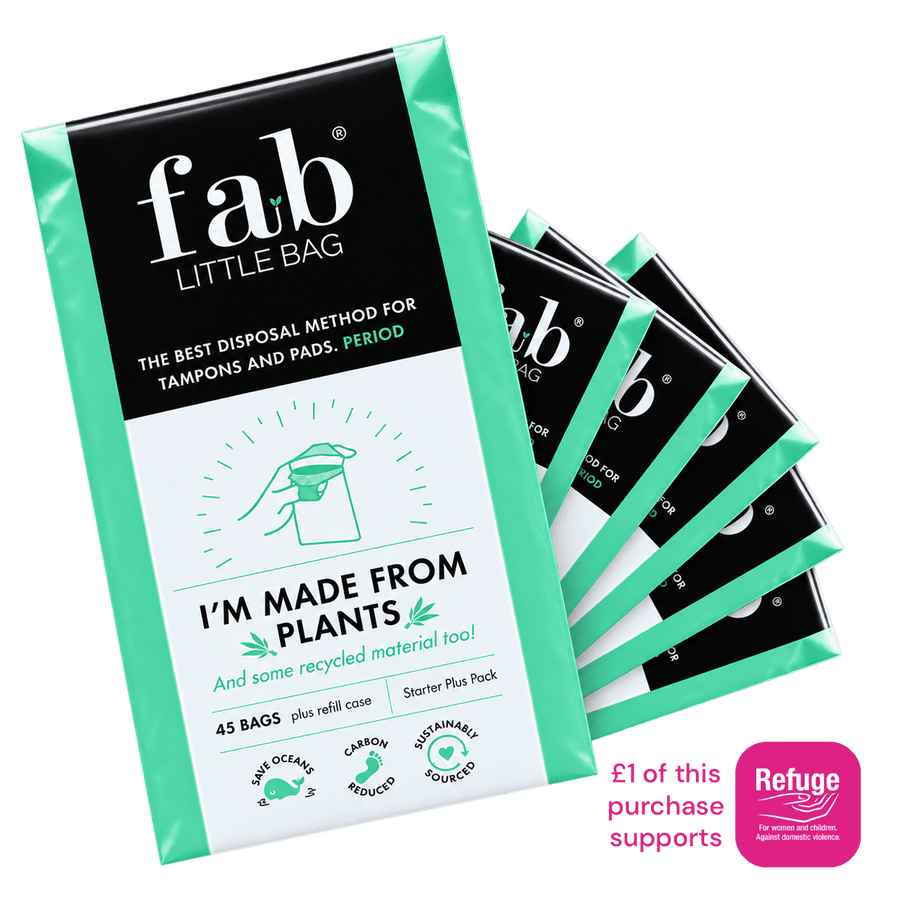
125 FabLittleBags across six packs, plus a carry case for your bag. Each bag opens with one hand, is opaque and seals shut, so frequent changes on heavy or unpredictable days are quick and discreet. Made mostly from plants.
Protect your sleep. Night sweats and heavy bleeding at night can both disrupt sleep. A dark towel on the bed, spare underwear by the bed and a cool bedroom can all help. The NHS suggests lightweight clothing, a fan and keeping your bedroom cool for night sweats.
Talking to a GP about perimenopause
You do not need to wait until your symptoms are severe to talk to a GP. The NHS says to contact a GP if you think you have symptoms of menopause or perimenopause and want to know what your options are.
To get the most from the appointment:
- Take your period and symptom record. Even a few months of notes helps.
- Lead with what matters most to you. If it is heavy bleeding, sleep or mood, say so first.
- Mention everything that has changed, even if it seems unrelated.
- Ask what happens next, including any tests and when you should come back.
Depending on your symptoms, the NHS says a GP may talk to you about:
- Hormone replacement therapy (HRT), which replaces the hormones that fall during menopause and is available in several forms
- Vaginal oestrogen, for vaginal dryness, soreness and some urinary symptoms
- Non-hormonal options, if you cannot or do not want to take HRT
- Cognitive behavioural therapy (CBT), a talking therapy that can help with low mood, anxiety, sleep problems, hot flushes and night sweats
The NHS also says there is very little evidence that herbal remedies help, and that some can interact with other medicines, so talk to a doctor or pharmacist before trying them.
Do not forget contraception. You can still get pregnant during perimenopause, even if your periods are irregular. The usual advice from NHS menopause services is to keep using contraception for 2 years after your last period if you are under 50, and for 1 year if you are 50 or over. Ask your GP, nurse or a sexual health clinic what is right for you.
Looking after yourself through perimenopause
Alongside any treatment, the NHS suggests some everyday things that can help:
- Try to keep regular sleep routines and get plenty of rest
- Eat a healthy, balanced diet
- Exercise regularly, including weight-bearing exercise to keep your bones strong
- Try relaxing activities such as yoga, tai chi or meditation
- Do not smoke, and keep alcohol within recommended limits
- Talk to other people going through the same thing
Perimenopause can feel isolating, so do lean on friends, family and charities such as The Menopause Charity.
For another perspective on periods and the menopause, read Eleanor Luxton's post, Periods and Menopause: What You Need to Know.
When to get help, and how quickly
Call 999 if you could be pregnant and you are bleeding and:
- You have severe tummy pain, or pain in your shoulder
- You feel sick, faint or dizzy
- The bleeding is heavy, for example soaking a pad soon after putting it on
Ask for an urgent GP appointment or call NHS 111 if:
- Your period pain or pelvic pain is severe or worse than usual, and painkillers have not helped
See a GP if:
- Your periods have changed and you are bleeding more, not less, than before
- You are bleeding between periods or after sex
- You have not had a period for 12 months or more and you have any vaginal bleeding, even once or only a little
- Heavy periods are affecting your daily life, or your periods are very painful
- You are on HRT and still having irregular or heavier bleeding after 6 months
- You have palpitations
- You think you have perimenopause symptoms and want to talk about your options
A GP will not think you are wasting their time. These are exactly the conversations they are there for.
Your perimenopause and periods checklist
☐ I know the difference between perimenopause, menopause and postmenopause
☐ I am keeping a simple record of my periods and other symptoms
☐ I know that bleeding more, not less, is a reason to see a GP
☐ I know that any bleeding between periods, after sex or after 12 months without a period needs checking
☐ I carry a small period kit, with disposal bags, in every bag I use
☐ I have enough products and bags at home for heavier or longer periods
☐ I am still using contraception, and I know when I can stop
☐ I have booked, or I know when I will book, a GP appointment to talk about my options
Frequently asked questions
What is perimenopause?
Perimenopause is the time when your hormone levels start to fall and your periods become irregular, before they stop altogether. The NHS says menopause usually affects women between the ages of 45 and 55, but it can happen earlier, and it can affect anyone who has periods. You reach menopause when you have not had a period for 12 months and are not using hormonal contraception.
How do periods change during perimenopause?
The NHS says one of the first signs of perimenopause is usually a change to your periods. They may become more or less frequent, and the bleeding may become heavier or lighter, before your periods eventually stop. Many people find their cycle becomes less predictable, with skipped periods, shorter or longer gaps between periods, and changes in how long each period lasts.
Is it normal to have heavier periods in perimenopause?
Heavier periods can happen as you approach menopause, but the NHS says to see a GP if your bleeding pattern has changed and you are bleeding more, not less, than before. You should also see a GP if heavy periods are affecting your daily life. Conditions such as fibroids and polyps can cause heavier bleeding, and a GP can check what is going on and talk to you about treatment.
Can you get pregnant during perimenopause?
Yes. You can still get pregnant during perimenopause, even if your periods are irregular. The usual advice from NHS menopause services is to keep using contraception for 2 years after your last period if you are under 50, and for 1 year if you are 50 or over. Speak to your GP, a practice nurse or a sexual health clinic about what is right for you.
What counts as postmenopausal bleeding?
Postmenopausal bleeding is any vaginal bleeding after you have not had a period for 12 months or more. The NHS says it is not usually serious, but it can be a sign of cancer, so you should always see a GP. That applies even if it happened only once, there was only a small amount of blood, spotting or pink or brown discharge, you have no other symptoms, or you are not sure it was blood.
When should I see a GP about perimenopause?
The NHS says to contact a GP if you think you have symptoms of menopause or perimenopause and want to know your options, if you have palpitations, if you are bleeding more than before, or if you have any bleeding after 12 months without a period. You should also see a GP about bleeding between periods or after sex, or periods that are very painful or affecting your daily life.
Resources
- NHS: Menopause and perimenopause for an overview, with links to symptoms, treatment and support
- NHS: Symptoms of menopause and perimenopause including changes to periods and when to see a GP
- NHS: Treatment for menopause and perimenopause for HRT and other options
- NHS: Post-menopausal bleeding for causes and what happens at the GP
- NHS: Heavy periods for what counts as heavy and when to get help
- Women's Health Concern, the patient arm of the British Menopause Society
- The Menopause Charity for information and support
- Rock My Menopause for information and support on perimenopause and menopause
FabLittleBag makes opaque, sealable disposal bags that open with one hand, made mostly from plants, so even the most unpredictable periods are a little easier to manage wherever you are.