


Crohn's, Colitis and Life with a Stoma: A Practical Guide
For many people with Crohn's disease or ulcerative colitis, a stoma is the operation that gives them their life back. Here is what to expect, how to feel confident day to day, and advice from a specialist nurse who supports people through it.
Crohn's & Colitis Awareness Week runs from 1 to 7 December, and this year's theme from Crohn's & Colitis UK is "Come Closer". It is a good moment to talk about something that is part of life for many people with inflammatory bowel disease, but that rarely gets discussed openly: living with a stoma.
Crohn's & Colitis UK says that 25,000 people in the UK will be told they have Crohn's or Colitis this year. Most will manage with medicines and support from their care team. For some, surgery and a stoma become part of the picture.
This guide covers why a stoma might be needed, the first weeks, everyday life, confident disposal and when to get help. We are very grateful to Stephanie Delaunay, IBD Specialist Nurse and prescriber, who shared her advice from years of supporting people with a stoma.
A note before we start: this article is general information based on NHS guidance, charity information and a specialist nurse's experience. It is not personal medical advice. Your own surgical team and stoma nurse know your situation best, so please follow their advice first.
Crohn's disease and ulcerative colitis: a quick introduction
Crohn's disease and ulcerative colitis are the two main types of inflammatory bowel disease (IBD). They are not the same as irritable bowel syndrome (IBS).
Crohn's disease is described by the NHS as a long-term condition where part of your gut becomes inflamed. It cannot currently be cured, but treatment can help control symptoms.
Ulcerative colitis is a condition where parts of your large bowel (colon) and rectum become inflamed. The NHS describes it as one of a group of conditions called inflammatory bowel disease.
Both conditions tend to come and go, with flare-ups and calmer periods, and that unpredictability is one of the hardest parts of living with them.
When a stoma comes into the picture
A stoma is an opening made in your tummy during surgery, where the end of your bowel is brought through so that poo can leave your body and be collected in a bag, often called a pouch or appliance.
There are two main types:
- An ileostomy, where the end of your small bowel is brought through an opening in your tummy
- A colostomy, where part of your large bowel is brought through an opening in your tummy
Some stomas are temporary, to let part of the bowel rest and heal, and can be reversed later. Others are permanent. Your surgical team will explain which applies to you and why.
Why someone with Crohn's might have a stoma
The NHS says you might be offered surgery for Crohn's disease if your symptoms only affect certain parts of your gut, or if you have severe symptoms and medicines are not working. This may involve removing part of the gut, sometimes with an ileostomy or colostomy. Symptoms can come back elsewhere in the gut after surgery, so ongoing care stays important.
Why someone with ulcerative colitis might have a stoma
For ulcerative colitis, the NHS says surgery may be recommended if the condition is significantly affecting your life, your bowel is severely damaged, your symptoms keep coming back, or other treatments have not helped. You may also need emergency surgery if you have a very bad flare-up.
The operation is called a colectomy. Afterwards, the NHS describes two main options: an ileostomy, where poo is collected in bags attached to the opening, or an ileo-anal pouch, often called a J-pouch, which is made from the small bowel so you can poo normally.
For many people with severe IBD, surgery is the start of feeling well again.
The first few weeks
Coming home with a new stoma can feel like a lot to take in. Stephanie's first message to her patients is one of reassurance.
"I always reassure my patients that, with time and practice, they will be managing their stoma like a pro! In the beginning, everything may feel new and overwhelming, but gradually, changing and caring for their stoma will become part of their normal routine. I encourage them to think of their stoma as a different way for their body to pass stool, rather than something that should limit their lives." Stephanie Delaunay, IBD Specialist Nurse
She is also honest that things will not always go perfectly.
"I also explain that accidents can happen, including leaks, and that this is completely normal. It can happen to anyone, especially while learning to manage a stoma. If it happens, there is no need to feel embarrassed or lose confidence. It is all part of the learning process."
The NHS gives some useful guidance for recovery:
- Recovery time. Recovery usually takes 6 to 8 weeks after an ileostomy, and around 8 weeks after a colostomy.
- Activity. Gentle exercise, such as a short walk, is encouraged. Avoid strenuous activity and heavy lifting for a while. The NHS says around 3 months after an ileostomy and 8 weeks after a colostomy, but your team will advise you.
- Eating. You will usually be advised to follow a low-fibre diet for a few weeks after surgery, then return to a healthy, balanced diet. Chewing food well and eating regularly helps prevent your stoma becoming blocked.
- Drinking. Drink plenty of fluids to avoid dehydration. This matters particularly with an ileostomy.
- Medicines. The NHS notes that slow-release medicines may not work as well, and could come straight out into your bag. Ask your doctor or pharmacist about other forms, and do not stop any prescribed medicine without speaking to them.
Your stoma nurse is your most important support in these weeks, from changing your bag to finding the right products.
Everyday life with a stoma
One of the most common worries after stoma surgery is that life will be smaller. For most people, it is not. Stephanie puts it simply:
"The stoma is there to improve their health and quality of life, and it is important to focus on what they can do rather than what they fear they might not be able to do... Having a stoma should not stop anyone from living life to the fullest."
Clothes. The NHS says you should be able to wear your usual clothes.
Work. The NHS says you should be able to go back to work when you feel well enough. If your job involves heavy lifting, talk to your employer about it.
Sex and relationships. The NHS says you can have sex again once you feel ready. Your stoma nurse can help with any worries about sex, relationships or body image, so do ask.
Swimming and exercise. Stephanie notes that enjoying the beach, swimming in the sea and going to the pool are all things people with a stoma can carry on doing. We have a full guide to swimming and summer with a stoma.
Travel. Pack more supplies than you think you need, in your hand luggage, and ask your stoma nurse about longer trips.
For a more detailed look at the first year, read our practical first-year guide to adjusting to life with a stoma.
Confident disposal, at home and out and about
Dealing with used stoma bags can cause a lot of anxiety, especially away from home. A little preparation makes a big difference.
At home
- Empty or change your bag in the way your stoma nurse has shown you. Some bags can be drained into the toilet. Others are changed when full.
- Seal each used bag before it goes in the bin. A sealable, opaque disposal bag keeps odour in and means nobody can see what is inside.
- Put sealed bags in your general waste bin. A bin with a lid in the bathroom, emptied regularly, keeps things fresh.
- Never flush a stoma bag, wipes or adhesive remover wipes. They do not break down and can block pipes.
Out and about
Stephanie's biggest tip is about being prepared.
"My biggest tip is to always carry a small stoma emergency bag containing everything you need to change your appliance comfortably and confidently when away from home. I recommend carrying one or two spare stoma bags, already cut to the correct size, small disposal bags, adhesive remover wipes or spray, and any additional products specific to your needs, such as a seal or ring, or stoma paste. Being prepared means you can manage any unexpected leaks or changes without unnecessary stress."
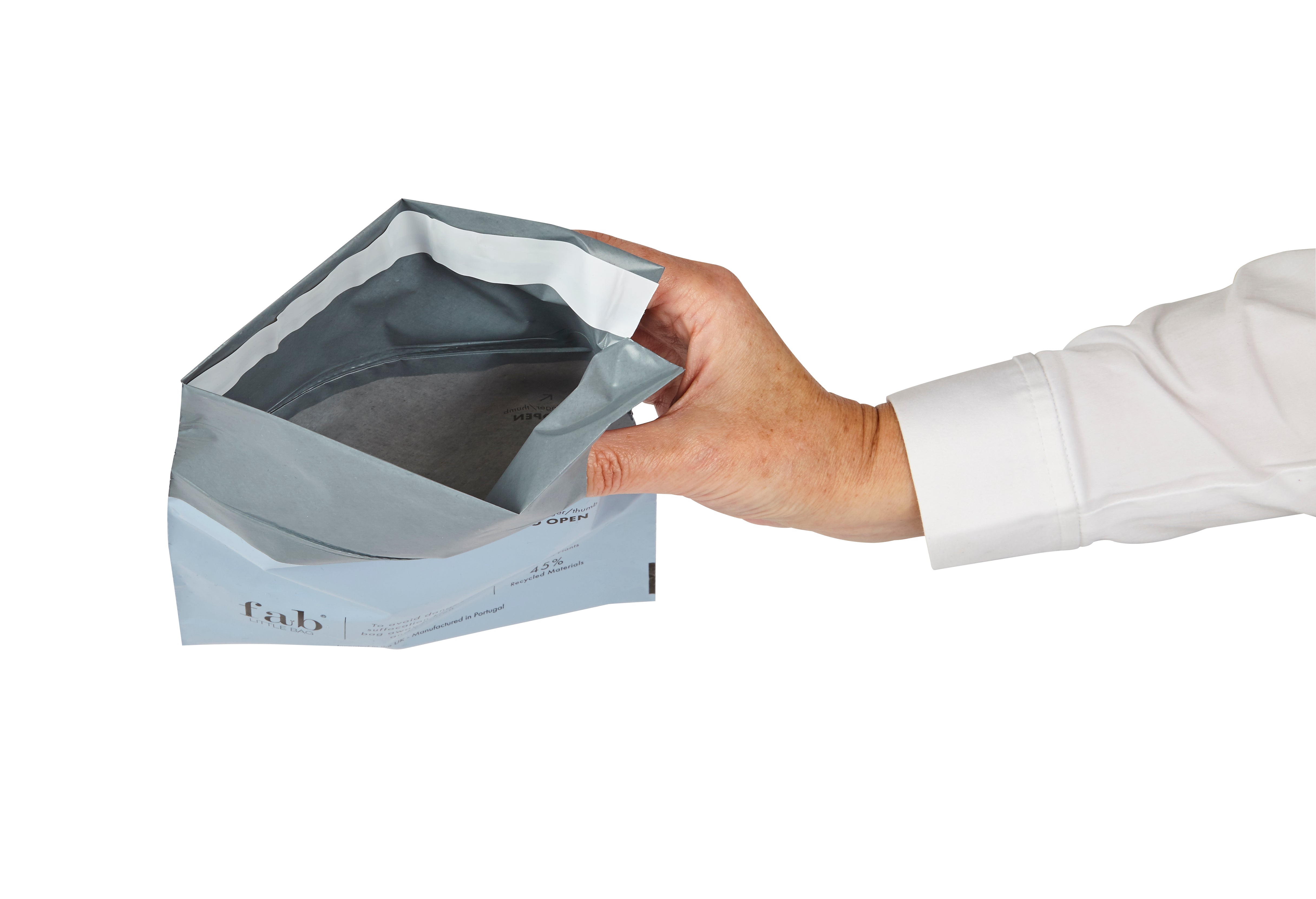
From our shop
HyGeeni Disposal Bags · £12.99
Opaque, sealable disposal bags made for stoma bags, as well as catheters and incontinence pads. They open with one hand and seal firmly shut to hold in odour, and they are small enough to keep in your emergency kit, bag or pocket. Made mostly from plants. 50 bags per pack.
Know where you can go. Many accessible toilets are locked under the National Key Scheme, and the NHS mentions the RADAR key as a way to access them. Colostomy UK sells RADAR keys and says they give access to over 9,000 accessible toilets across the UK.
When there is no bin. Many toilets, especially men's toilets, still have no bin in the cubicle, and Colostomy UK campaigns for one in every cubicle. Until then, seal the used bag and take it to the next general waste bin.
As Stephanie says: "Preparation is key, but a stoma should never be a reason to stay at home."
Never running out
A regular delivery means there is always a pack in the cupboard and one in your kit.

From our shop
HyGeeni 100 Quarterly Subscription · £19.99 a quarter
100 HyGeeni disposal bags delivered every three months, so you never have to remember to reorder. Ideal for anyone changing a stoma bag every day, and for households where more than one person uses HyGeeni bags.
Looking after your stoma: when to get help
Stephanie is clear that you should never wait until something gets worse.
"I always encourage patients to contact their stoma nurse if they experience persistent leakage, soreness or skin damage around the stoma, changes in their stoma output, problems with their appliance, or concerns about the appearance of their stoma. They should also seek support if they feel anxious, lack confidence, or are struggling to adjust to life with a stoma."
"Patients should never feel that they are bothering their stoma nurse by asking for advice. We are here to support them, help prevent complications, and give them the confidence to live their lives as fully as possible."
She also flags the signs that need urgent attention. Severe tummy pain, persistent vomiting, a swollen stoma, or little or no output, particularly from an ileostomy, may mean a blockage and need urgent medical assessment.
The NHS also highlights dehydration, especially with an ileostomy (signs include tiredness, a dry mouth or a lot of output), and blockage (cramps, feeling sick and swelling around your stoma), which it says to raise with your stoma nurse urgently.
When to get help, and how quickly
Call 999 or go to A&E if you have ulcerative colitis and:
- You have severe tummy pain
- You are bleeding non-stop from your bottom
- There is a lot of blood, or you see large blood clots, when you poo
- You are vomiting blood or poo, or your sick looks like coffee grounds or soil
The NHS says not to drive yourself to A&E. Ask someone to drive you, or call 999 for an ambulance.
Ask for an urgent GP appointment or call NHS 111 if you have a stoma and:
- Your temperature is very high
- There is a lot of blood coming from your stoma or in your stoma bag
- You have signs of dehydration
- Your stoma has not been active for more than 12 hours (ileostomy), or for much longer than is normal for you (colostomy)
- You have severe tummy pain or cramps, or you feel sick or are being sick
Also ask for an urgent GP appointment or call NHS 111 if you have Crohn's or colitis and:
- Your poo is black or dark red, or you have bloody diarrhoea
- You have very bad diarrhoea, a high temperature, or a fast heartbeat
- You cannot fart or poo
Contact your stoma nurse or GP if:
- You think you have a problem with your stoma, or it is causing skin problems
- You have leaks that keep happening, soreness, or changes in your output
- You are struggling emotionally or finding it hard to adjust
If you have a severe flare-up, you can also contact your IBD care team directly.
Looking after your wellbeing
The NHS acknowledges that it is common to feel stressed, anxious or embarrassed when living with ulcerative colitis, and the same is true for many people adjusting to a stoma. Your stoma nurse and IBD team can help, and so can Crohn's & Colitis UK, Colostomy UK and IA, the Ileostomy and Internal Pouch Association. This Awareness Week, sharing even a little of your experience can make a real difference to someone just starting out.
Your stoma confidence checklist
☐ I know whether my stoma is an ileostomy or a colostomy, and whether it is temporary or permanent
☐ I carry an emergency kit with spare bags, disposal bags, wipes and any extras I use
☐ I seal used bags before binning them, and never flush them
☐ I know the signs of dehydration and of a blockage
☐ I know when to call 999, when to call NHS 111 and when to call my stoma nurse
☐ I have a RADAR key, or I know where to get one
☐ I know where to find support from people who understand
Frequently asked questions
Why do people with Crohn's or colitis need a stoma?
Most people with Crohn's disease or ulcerative colitis never need a stoma. The NHS says surgery may be offered for Crohn's if symptoms only affect certain parts of the gut, or if symptoms are severe and medicines are not working. For ulcerative colitis, surgery may be recommended if the condition is significantly affecting your life, your bowel is severely damaged, symptoms keep coming back or other treatments have not helped. Surgery can involve forming a stoma.
What is the difference between an ileostomy and a colostomy?
An ileostomy is an operation that brings the end of your small bowel through an opening in your tummy to form a stoma. A colostomy brings part of your large bowel through an opening in your tummy. People with ulcerative colitis who have their large bowel removed usually have an ileostomy, or an ileo-anal pouch, also called a J-pouch, which lets them poo normally.
How long does it take to recover from stoma surgery?
The NHS says recovery usually takes 6 to 8 weeks after an ileostomy and around 8 weeks after a colostomy. You will be encouraged to do gentle exercise, such as short walks, but to avoid heavy lifting and strenuous activity for a while. You will usually follow a low-fibre diet for a few weeks before returning to a healthy, balanced diet. Your stoma nurse will guide you through it.
How do you dispose of a used stoma bag?
Seal the used bag in an opaque disposal bag and put it in your general waste bin. Never flush a stoma bag, wipes or adhesive remover wipes down the toilet, because they can block pipes. When you are out, carry a few disposal bags in your emergency kit so you can always seal a used bag and take it to the next bin, even if there is no bin in the cubicle.
What are the signs of a stoma blockage?
The NHS lists cramps, feeling sick and swelling around your stoma as signs of a blockage, and says to speak to your stoma nurse urgently. Get an urgent GP appointment or call NHS 111 if your stoma has not been active for more than 12 hours with an ileostomy, or much longer than usual with a colostomy, or if you have severe tummy pain, cramps or vomiting.
Can you swim and exercise with a stoma?
Yes. Specialist nurse Stephanie Delaunay says enjoying the beach, swimming in the sea and going to the pool are all things people with a stoma can carry on doing. The NHS encourages gentle exercise during recovery, and your stoma nurse can advise on when to return to more demanding exercise.
Resources
- NHS: Crohn's disease for symptoms, treatment and when to get help
- NHS: Ulcerative colitis for symptoms, surgery and when to get help
- NHS: Ileostomy for recovery, living with an ileostomy and complications
- NHS: Colostomy for recovery, living with a colostomy and complications
- Crohn's & Colitis UK helpline on 0300 222 5700, 10am to 3pm, Monday to Friday
- Colostomy UK Stoma Helpline on 0800 328 4257, 9am to 10pm, 365 days a year, and RADAR keys
- IA, the Ileostomy and Internal Pouch Association for support for people with an ileostomy or internal pouch
- Stoma Reversal: What to Expect Before, During, and After Surgery if your stoma is temporary
With thanks to Stephanie Delaunay, IBD Specialist Nurse and prescriber, and Lindsay Rainford, Colorectal Specialist Nurse and prescriber, for their advice.
HyGeeni makes opaque, sealable disposal bags that open with one hand, made mostly from plants, so every stoma bag change ends cleanly and discreetly, wherever you are.