


The Confident Period: Myths, Facts and Our Best Advice
Eight things a lot of people still believe about periods, what the NHS actually says, and the practical advice we would give a friend. Plus everything else we have written this quarter, in one place.
Most of what we learn about periods arrives early, from other people who were also guessing. A friend at school, an older sibling, a leaflet, a rumour. Some of it turns out to be right. A surprising amount of it is wrong, and the wrong bits are rarely harmless, because they are usually the ones that stop people asking for help.
So this is our myth-busting piece. Eight things we hear a lot, what the evidence says, and the advice we would actually give.
A note before we start: this is general information based on NHS guidance, not personal medical advice. If something here sounds like you, that is a reason to speak to a GP or pharmacist rather than a reason to worry quietly.
Myth 1: A 28-day cycle is normal and anything else is not
The fact. The NHS puts the average at around every 28 days, and then immediately says that "it's common for periods to be more or less frequent than this, ranging from every 21 days to every 35 days". Your period itself can last between 2 and 7 days, and usually runs to about 5.
That is a wide window, and most people sit somewhere in it without anything being wrong. The 28-day figure got famous because it is a tidy number, not because it is a rule.
Our advice. Track your own pattern rather than measuring yourself against the average. What matters clinically is a change from your normal, not the distance between your normal and someone else's. We wrote about that in detail in Know Your Normal.
Myth 2: Really heavy periods are just bad luck
The fact. Heavy periods have an actual definition, and it is more specific than most people expect. The NHS says you may have them if you need to change your pad or tampon every 1 to 2 hours, need to use two types of product at once, have periods lasting more than 7 days, pass clots bigger than about 2.5cm, bleed through to your clothes or bedding, or avoid daily activities because of your periods.
Feeling tired or short of breath a lot is on that list too, because heavy bleeding can affect iron levels.
Our advice. If two or more of those describe you, that is a GP conversation, not a stoicism competition. The NHS is explicit that you should see a GP if heavy periods are affecting your life or you have had them for some time. There is treatment, and "I have always been like this" is not a reason to be told no.
The reason the tiredness marker matters is that persistent heavy bleeding can pull your iron down over months, and the symptoms of that get written off as being generally run down. If you are asking for an appointment about heavy periods, it is reasonable to ask whether your iron should be checked at the same time.
Myth 3: Period pain is just something you put up with
The fact. Some cramping is ordinary, caused by the womb tightening. Pain that stops you living your life is not, and the NHS treats it as a symptom worth investigating. Underlying causes it names include endometriosis, adenomyosis, fibroids, pelvic inflammatory disease and, in some cases, an IUD.
The NHS list for seeing a GP includes periods becoming more painful, heavier or irregular, pain that stops you doing your usual daily activities, pain during sex or when peeing or pooing, bleeding between periods, a swollen tummy, loss of appetite, or losing weight without trying. It also says to get an urgent appointment or call 111 if the pain is severe or getting worse despite painkillers.
Our advice. Write down how many days a month your period costs you. Turning "it's quite bad" into "I lose two days every cycle" changes the appointment completely. Average diagnosis times for conditions like endometriosis are long, and being specific is the best lever you have.
Myth 4: You should not swim or exercise on your period
The fact. The opposite, if anything. Gentle exercise is on the NHS's own list of things that help period pain, and swimming is named specifically alongside yoga, walking and cycling.
There is no medical reason to sit a week out every month, and no, you will not leave a trail in the pool. Water pressure and a tampon or cup between them handle it.
Our advice. Work with your cycle rather than ignoring it, which is what most athletes do. We went into this properly in Exercising on Your Period, and for holidays and hot climates there is The Ultimate Period Travel Guide.
Myth 5: A tampon can get lost inside you
The fact. It cannot. The vagina is a closed space at the top, and there is nowhere for a tampon to travel to. If you cannot feel the string, the tampon is still in the vagina and it can be removed, usually by you, sometimes by a clinician.
What does happen, and is worth taking seriously, is a tampon being forgotten and left in for too long.
Our advice. If you cannot get one out, a GP or sexual health clinic will remove it without any fuss and without making you feel foolish. It is a common appointment. Leaving it because you are embarrassed is the only version of this with a bad outcome.
Myth 6: Tampons commonly cause toxic shock syndrome
The fact. Toxic shock syndrome is real, and the NHS describes it as "a rare but life-threatening condition caused by an infection". Both parts matter. It is genuinely rare, and it is genuinely serious, and neither half should be dropped to make a point.
The NHS guidance on prevention is simple: wash your hands, follow the instructions, and do not leave a tampon or cup in longer than needed or recommended. Call 999 or go to A&E if there is confusion, slurred speech, blue or pale skin, a rash that does not fade, difficulty breathing, or large areas of peeling skin. Contact NHS 111 if you suspect TSS with fever, chills, vomiting, severe body pain or a rash like sandpaper.
Our advice. Set an alarm on heavy days if you are someone who loses track. That is the whole risk management strategy. Fear of TSS keeps some people away from a product that would otherwise suit them better, and proportion is the useful thing here.
Myth 7: You cannot get pregnant on or just after your period
The fact. The NHS says it is "possible (although not very likely) to get pregnant soon after your period finishes if you ovulate early or have a short menstrual cycle". Sperm can survive in the fallopian tubes for up to 7 days after sex, and ovulation happens around 10 to 16 days before your next period, which lands in a different place for everyone.
The day-14 rule applies to a textbook 28-day cycle and, as Myth 1 covered, plenty of people do not have one.
Our advice. Do not use your period as contraception. If you need contraception, use contraception. A pharmacist can talk you through the options without a GP appointment.
Myth 8: If a product is organic or plant-based, it is fine to flush
The fact. No period product should go down the toilet, whatever it is made from. The material does not change the plumbing.
The scale is genuinely startling. According to figures cited by the UK government, around 2.5 million tampons, 1.4 million pads and 700,000 panty liners are flushed every single day in the UK, and water companies spend in the region of £100 million every year dealing with the blockages that result.
Our advice. This is the one we exist for, so we will be brief. Everything goes in a bin. If the barrier is that there is no bin, or that the bin is across the room, or that you are in someone else's bathroom, that is a solvable problem rather than a reason to flush. We looked at why people flush anyway in Why 40% of UK Women Still Flush Period Products.
Our best advice, in practice
Confidence is mostly logistics. The people who never seem caught out are not luckier, they are just carrying the right small things.
Keep a kit somewhere permanent. Not the bag you might take, the bag you always take. Two products, a spare pair of underwear on heavy days, and disposal bags.
Have a disposal answer before you need one. This is the difference between a non-event and a small crisis in a bathroom with no bin.

From our shop
The Fab 45 (+ carry case) · £10.00
Forty-five FabLittleBags plus a discreet carry case. One-handed opening, opaque, seals shut, and made from 60% sugarcane, 30% recycled plastic and 10% cornstarch. The simplest way to stop the no-bin problem happening again.
Track two things, not ten. Start date and anything that felt different. That is enough to spot a change and enough to take to a GP.
Decide what you actually want to use. Plenty of people are using the product they were handed at fourteen. Pads, tampons, cups and period underwear all suit different bodies and different weeks, and it is fine to mix. We compared them in Back to Basics and looked at what is inside them in What's Really Inside Your Period Products?.
Say it out loud once. Whether that is telling a partner what you actually need in a bad week, asking a manager for a bin in the accessible loo, or telling a teenager that periods are a normal thing that happens in this house. Most of the awkwardness around periods survives because nobody ever says the sentence, and it almost always turns out to be less of a moment than expected.
Sort out the out-and-about version. Most period anxiety happens away from home.
From our shop
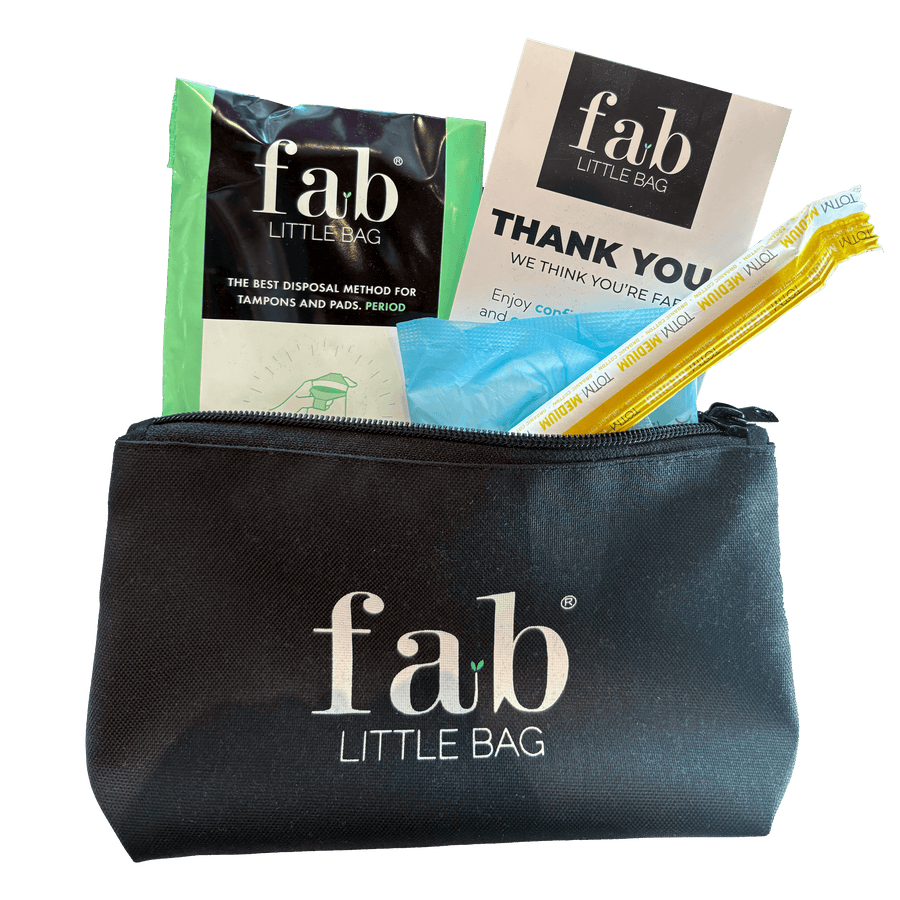
On-the-Go Period Bag · £12.00
A compact bag holding seven FabLittleBags with a carry case, plus an emergency organic cotton tampon and pad from TOTM. Everything in one place, so the whole kit moves with you between handbags, gym bags and desk drawers.
The red flags worth acting on
Short version, from NHS guidance.
Call 999 or go to A&E if there is confusion, slurred speech, blue or pale skin, a rash that does not fade, difficulty breathing or large areas of peeling skin, which can indicate toxic shock syndrome.
Ask for an urgent GP appointment or call NHS 111 if period pain is severe or getting worse despite painkillers.
See a GP if you are bleeding between periods, after sex or after the menopause; your periods have become more painful, heavier or irregular; period pain is stopping you doing normal daily things; heavy periods are affecting your life; you have pain during sex or when peeing or pooing; you have a swollen tummy, loss of appetite or unexplained weight loss; or you have missed three periods in a row and a pregnancy test is negative.
None of that list is dramatic. All of it is a GP's ordinary Tuesday.
Everything else we wrote this quarter
If you landed here first, this is the rest of it.
- Know Your Normal: Period Changes Worth Paying Attention To
- Heading to University on Your Period: A Fresher's Survival Guide
- Exercising on Your Period: Training Through Your Cycle
- Your Period Questions, Answered
- What's Really Inside Your Period Products? Plastic, Plants and How to Choose
- The Ultimate Period Travel Guide: Holidays, Flights and Hot Climates
- Back to Basics: Everything You Need to Know About Tampons, Pads, and Beyond
- Urology Awareness Month: Understanding Your Bladder and When to Seek Help
Frequently asked questions
How long should a period last?
The NHS says a period can last between 2 and 7 days, and usually lasts about 5. Anything consistently longer than 7 days counts as one of the markers for heavy periods and is worth raising with a GP. As with cycle length, a change from your own normal matters more than where you sit against the average, so a period that suddenly gets much longer or much shorter is the thing to pay attention to.
How do I know if my periods are too heavy?
The NHS gives specific markers. Needing to change a pad or tampon every 1 to 2 hours, needing two types of product at once, periods lasting more than 7 days, passing clots larger than about 2.5cm, bleeding through to clothes or bedding, avoiding daily activities because of your periods, or often feeling tired or short of breath. If two or more of those apply, see a GP. Heavy periods are treatable and can affect your iron levels, so they are worth investigating rather than enduring.
Can I swim on my period?
Yes. There is no medical reason to avoid swimming, and the NHS actually lists swimming among the gentle exercises that can help with period pain, alongside yoga, walking and cycling. Use a tampon or a menstrual cup rather than a pad, since pads absorb water. You will not leak into the pool. If you would rather not use an internal product, period swimwear is another option.
Can a tampon get lost inside me?
No. There is nowhere for it to go, because the vagina is a closed space at the top. If you cannot feel the string, the tampon is still there and can be removed, usually by you. If you cannot get it out yourself, a GP or a sexual health clinic will do it quickly and without any fuss. Do not leave it because you feel embarrassed, because a tampon left in far longer than recommended is the genuine risk here.
Can you flush tampons or pads?
No, and that includes products described as organic or plant-based, because what a product is made from does not change what it does to pipes. Figures cited by the UK government put it at around 2.5 million tampons, 1.4 million pads and 700,000 panty liners flushed in the UK every day, with water companies spending in the region of £100 million a year dealing with the consequences. Everything goes in a general waste bin, wrapped if you would rather not see it.
When should I see a GP about my periods?
See a GP if you are bleeding between periods, after sex or after the menopause, if your periods have become more painful, heavier or irregular, if pain or heavy bleeding is interfering with your normal life, if you have pain during sex or when peeing or pooing, if you have a swollen tummy or unexplained weight loss, or if you have missed three periods in a row with a negative pregnancy test. Ask for an urgent appointment or call NHS 111 if period pain is severe or worsening despite painkillers.
Resources
- NHS: Periods for cycle length, duration and what counts as usual
- NHS: Period pain and NHS: Heavy periods
- NHS: Toxic shock syndrome for symptoms and when to get emergency help
- NHS: Can I get pregnant just after my period has finished?
- Endometriosis UK for a nurse-led helpline, support groups and a symptom diary, if painful periods are your issue
FabLittleBag makes opaque, sealable disposal bags that open with one hand, made mostly from plants, so that "there was no bin" stops being a reason to flush. We have been arguing about this since long before it was fashionable.